
Start here / system map
Architecture
How recommendation, identity, search, acquisition, verification, and Plex publication stay behind explicit boundaries.
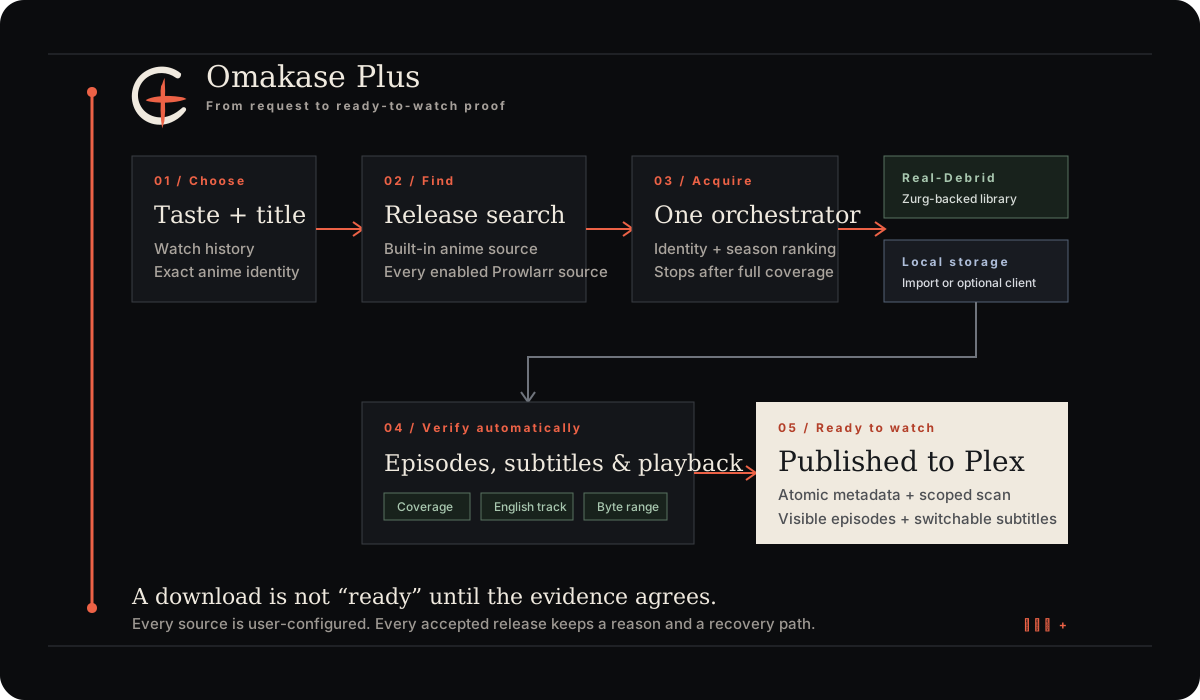
One orchestrator, several adapters
Omakase Plus keeps the product rules in one orchestrator and places provider behavior behind interfaces. Real-Debrid, local imports, and an optional scoped qBittorrent client can supply bytes without becoming the core data model.
That separation keeps the same safety contract across deployment modes:
- exact title and season identity;
- expected episode coverage;
- readable media inventory;
- subtitle policy;
- representative playback;
- deterministic Plex layout;
- receipts and recovery.
Provider-specific identifiers and statuses do not leak into public library names or replace the product’s readiness decision.
Request and identity
A request begins as a recommendation selection or a direct title. Omakase resolves it against AniList identity, including aliases, sequels, cours, arcs, spin-offs, and episode-numbering differences.
Ambiguous identity fails before provider mutation. This prevents a high-quality but wrong-season release from becoming a convincing library error.
Release search
The built-in anime release source can be joined by optional catalogs through Prowlarr. Omakase expands searches across titles and aliases, merges duplicate candidates, and ranks eligible results.
Each source is owner-configured. Prowlarr expands the configured pool; it does not bypass identity, subtitle, or playback checks. A partial source outage is visible without hiding successful results from other sources.
Acquisition and inventory
The acquisition adapter returns stable content identity and an inventory. Omakase can:
- adopt a compatible existing provider asset by stable hash;
- plan and apply a local file import;
- scope a local client to one category and save root.
Inventory is normalized before publication. Cross-title hash collisions, path escapes, changed plan inputs, and ambiguous episodes fail closed.
Verification
Media probes establish duration, streams, episode mapping, subtitle languages, and representative readability. Readiness prefers an embedded, switchable English subtitle from the exact media release because it shares the same video cut and timing.
Other embedded subtitle languages are retained for Plex and Infuse. A verified burned-in English release may be used only as a clearly labelled fallback after switchable-subtitle candidates are exhausted.
Atomic Plex publication
Omakase builds a versioned library generation, then moves the stable pointer atomically. Plex sees deterministic series and movie folders, posters, identity metadata, and scoped scans.
Ordinary synchronization does not delete provider media. Rollback selects a retained generation and restores associated state using the recorded receipt.
Airing titles
AniList airing data drives the next check time. Omakase schedules a check shortly after announced airtime, then bounded follow-ups while sources and providers catch up. A missing episode remains missing without blocking unrelated titles.
Read Airing automation for timing behavior and Plex libraries and scans for publication details.
A worked example / fictional observations
One request. Two candidates. The right episode.
Follow a fictional request for Lanterns at Dusk, season 1, episode 7. These are teaching records, not observations from a private library.
THE REQUESTSeason 1 · Episode 7Availability alone is not readiness.
CANDIDATE AA file is available.Inspect the identity ↓
- Title & season
- Match
- Episode bytes
- Episode 6, not 7
- Publication
- Withheld
Reject this candidate. Keep searching the configured pool.
Readable media for the wrong episode cannot satisfy this request.
CANDIDATE BThe request is matched.Inspect the verification ↓
- Title, season & episode
- Exact match
- Download access & inventory
- Readable episode 7
- Subtitle observation
- Same-release switchable English
- Playback observation
- Representative range readable
Verification complete in this example. Publication is a separate step.
A managed library generation, atomic promotion and a scoped Plex scan still need their own result. Nothing was published by opening this panel.